
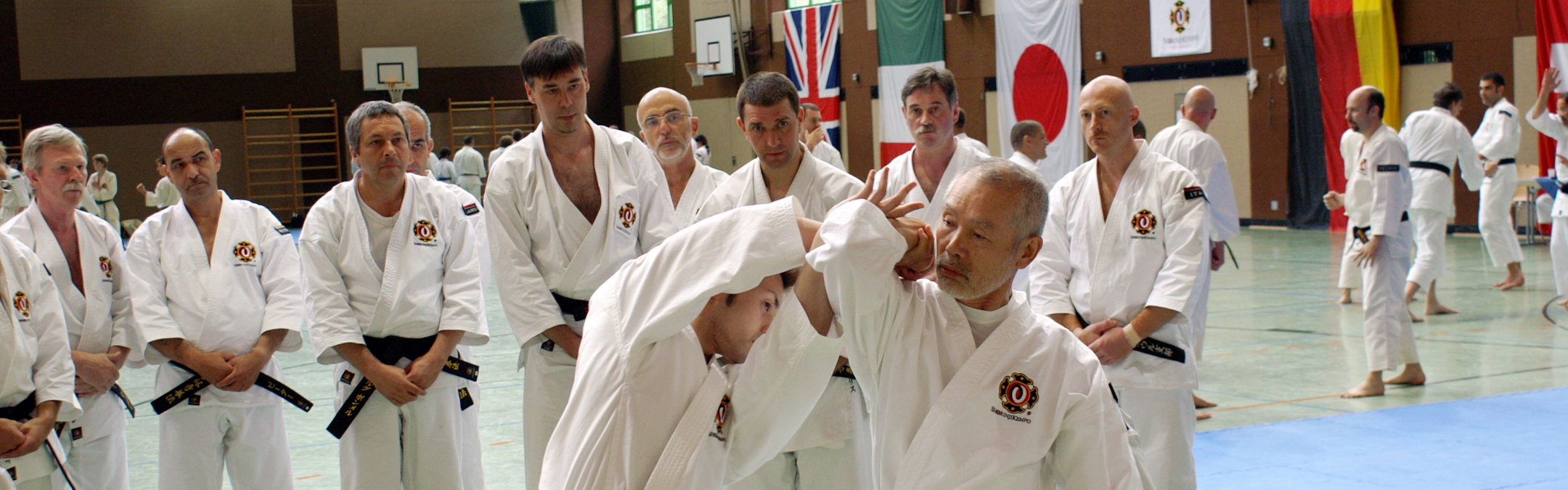
What is Shorinji Kempo?
Founded in Japan in 1947 by So Doshin, Shorinji Kempo is now a martial art that represents Japan more than ever. With Shorinji Kempo, So Doshin created a system that combines effective self-defense techniques with humanistic teachings. The self-defense system combines various elements of traditional Japanese and Chinese self-defense forms and is inseparably linked to So Doshin’s philosophy of self-defense and humanistic teaching. Shorinji Kempo is therefore not only an art of self-defense, but also a way of shaping character. Through a combination of learning together, mastering techniques, and its own teaching system, it teaches and promotes self-confidence, courage, vitality, compassion, and strives to develop personalities that support and enrich a peaceful society.
The essence of Shorinji Kempo is summed up perfectly in the following quote from So Doshin:
Half for one’s happiness, and half for happiness of others
Learn more about Shorinji Kempo at the website of the German Shorinji Kempo Association (German only) or Shorinji Kempo Unity.
About the Taikai
Shorinji Kempo is not centered around traditional competitive fighting or the pursuit of victory in matches. Instead, it emphasizes personal growth, mutual respect and technical mastery. One of the key events in the Shorinji Kempo calendar is the Taikai, a unique gathering that blends the spirit of a martial arts demonstration with elements of a friendly tournament. These events serve not only as showcases of skill but also as valuable opportunities for practitioners – known as kenshi – to connect with one another, often on a national or even international scale.
An essential part of the Taikai is the Kumi Embu, a choreographed performance in which two or more kenshi present a carefully scripted sequence of techniques. This form requires synchronization, precision and deep understanding between partners. Each embu is evaluated based on criteria such as coordination, technical accuracy, rhythm and the expressive quality of the movements. Importantly, there is no concept of “winning” or “losing” in Embu—its purpose lies in the demonstration of cooperative excellence and martial harmony, making it deceptively complex and demanding.
Ultimately, Shorinji Kempo Taikai reflects the art’s core philosophy: cultivating both body and mind through disciplined training, ethical practice and community spirit.
A Shorinji Kempo Taikai is usually held in conjunction with a study session, allowing all participants to practice and learn together, as well as to deepen the bonds between befriended kenshi and to make new friends. Personal connection and friendship is a very important part of the Shorinji Kempo community.
FAQ – general questions
Is it possible to watch the Taikai and Study Session as a visitor?
Yes, you are welcome to join for free as a visitor and take a look around. Space may be limited, but please give it a try. If you would like to receive lunch, please register here.
I am interested to try Shorinji Kempo by myself. How do I start?
The best way is to use a search engine to find local Shorinji Kempo clubs in your area. You should also be able to find all registered branches on this page of the World Shorinji Kempo Organization.
The website of the German federation also has an overview of the different dojos.
All clubs usually offer free trials for beginners.
What kind of techniques are part of Shorinji Kempo?
Shorinji Kempo techniques can generally be divided into Goho (hard techniques – 剛法) and Juho (soft techniques – 柔法).
Goho are technical methods for deflecting or blocking punches, kicks or similar attacks from an opponent in order to overwhelm them with a counterattack, again based on punches, kicks or similar techniques. Juho are techniques used when an opponent grabs your arm or clothing and you free yourself from the grip, apply a lever or throw the opponent.
Goho and Juho can be distinguished in this way, but with progressive training, Goho and Juho increasingly develop into a common set of techniques and the transitions between the two forms are fluid.
What are the principles of Shorinji Kempo?
Ken zen ichinyo – Body and mind are one
Ken zen ichinyo sums up a fundamental principle of Shorinji Kempo. Ken zen ichinyo means “body and mind are one.” This saying is based on the realization that although humans have a physical and a spiritual level, these are inseparably linked.
Accordingly, So Doshin always emphasized that neither mental nor physical training should be given priority, but rather that mind and body must be trained simultaneously and to the same extent.
So Doshin: “Zen is a matter of mind and heart*. However, the foundation is physical existence.”
riki ai funi – Strength and love belong together
An extremely important characteristic of Shorinji Kempo is riki ai funi – strength and love go together.
So Doshin: “Strength without love is nothing but violence, and love without strength is powerless.”
“If someone does not agree with our way of thinking, we should try to convince them. But if they want to impose their will by force, then I think we must respond with force. This is extremely blunt, but if this potential were not part of our training, then Shorinji Kempo would be meaningless.”
In other words, compassion and strength are often understood as opposing concepts, but in fact they belong together.
shushu kōjū – defend first, then attack
So Doshin: “We don’t need tough guys. All we need are people who don’t lose.”
Shorinji Kempo as self-defense is an “art of physical defense” against an opponent who intends to cause harm. Shorinji Kempo is based on techniques that are predominantly executed from a defensive position. The first goal is to protect yourself. On the other hand, Shorinji Kempo is not intended to defeat the opponent; it is enough not to lose against them.
fusatsu katsujin – do not kill, give life
A saying or technique such as “one blow, certain death” is not found in Shorinji Kempo. Originally, the motto was “do not kill, do not injure.” Later, So Doshin changed it to “Do not kill, give life.” It is not about defeating your opponent, but about stopping them and convincing them to desist from their actions. This way of thinking symbolizes fusatsu katsujin.
So Doshin: “Someone who wins through fighting is the lowest of the low. To truly win, you must convince the other person. If you do not gain their consent, it is not a victory.”
gōjū ittai – hard and soft combined
Shorinji Kempo as self-defense serves the purpose of protecting oneself from attacks. With the help of Shorinji Kempo techniques, it is possible to react to a wide variety of attacks and bring the opponent under control.
The various Shorinji Kempo techniques can be roughly divided into “hard” and “soft” techniques. Hard techniques – gōhō – mainly include punches, strikes, kicks, and blocks. Soft techniques – jūhō – on the other hand, essentially comprise releases, locks, throws, and holding techniques.
While Shorinji Kempo beginners initially learn gōhō and jūhō techniques separately, the boundary between them becomes increasingly blurred in the more complex techniques of higher grades, and it becomes clear that the most effective defense is to master both and understand how to use and combine them according to the situation.
So Doshin: “It is very good to seize the opportunity that arises and disappears in an instant and to react to changes.”
kumite shutai – joint training comes first
One of the special characteristics of Shorinji Kempo is kumite shutai – joint training comes first. This means that kenshi (those who train Shorinji Kempo) train together and thus help each other to improve. There are two important reasons for training together.
The first reason is technical. In individual training, it is simply not possible to develop the feel for the right timing, the right distance, etc. that is necessary for the effective application of the techniques. Shorinji Kempo is based on defensive techniques that incapacitate an attacking opponent. If no one takes on the role of the attacker, defense cannot be learned. This means that partners regularly switch roles between attacker and defender and help each other learn and improve the techniques.
The second reason is that partner training is the concrete implementation of the basic idea of Shorinji Kempo: people work together, take responsibility for each other, build trust, and grow together.
So Doshin repeatedly condemned thinking in terms of victory and defeat and the pursuit of defeating others.
He said: “To live in a world of victory and defeat, you must not see anyone but yourself. If you are only concerned with losing your status, even the youngest become your enemies. Without knocking them off their chairs, you cannot rise yourself. That way, you will not find a single friend. […] Shorinji Kempo aims to combat precisely this way of thinking.”

 English (UK)
  Deutsch
  Español
  Italiano
  Français
  Português